Call Me
+86-21-50125451
Search
CN

Email
tinali02@126.com
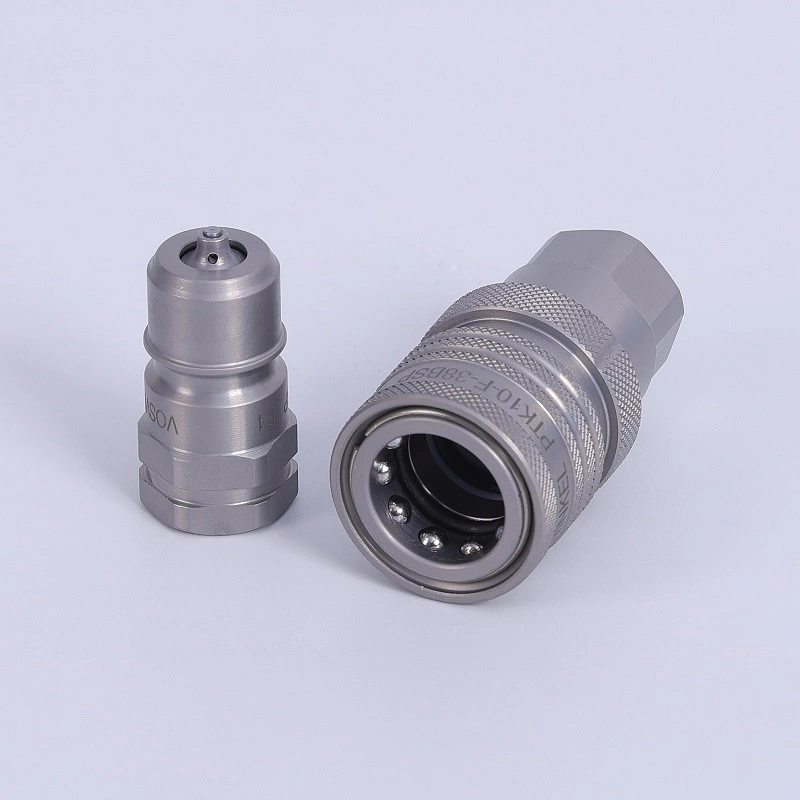
In hydraulic systems, quick-connect couplings are the core hubs for pipeline connection and disconnection, and their engineering value is well-known in the industry. However, disassembling the coupling reveals a hidden core component that is easily overlooked—a tiny precision spring that presses down the valve core.
This seemingly insignificant spring actually shoulders a crucial mission: maintaining precise sealing preload during tens of thousands of insertion and removal cycles, firmly guarding the system's bottom line to prevent internal leakage, isolate external contamination, and achieve zero media leakage. If the spring becomes fatigued, corroded, or broken, it can lead to anything from minor oil leaks at the coupling to severe hydraulic system shutdowns and paralysis.
So, should the spring inside a quick-connect coupling be made of carbon steel or stainless steel? What are the core differences between the two materials, and what operating conditions are they suitable for? This article will dissect the material selection logic and engineering truth behind this tiny component.
Carbon steel springs are the mainstream standard for hydraulic quick-connect couplings and the mainstay of large-scale industrial applications.
Core Advantages: High strength, excellent elasticity, and controllable cost. Commonly used carbon steel wires such as 65Mn and 70# offer tensile strengths of 1500–1900 MPa and an elastic modulus of approximately 206 GPa. Under the same structural dimensions, it can output greater elastic force than stainless steel, supporting stringent sealing and pre-tightening requirements. Furthermore, carbon steel raw materials are readily available, processing technology is mature, and mass production cost advantages are significant, making it the preferred choice for general operating conditions.
Material Characteristics: It inherently possesses good high-temperature resistance, and its strength and toughness can be further enhanced through alloy tempering. To compensate for its corrosion resistance shortcomings, the industry commonly employs surface protection processes such as galvanizing, nickel plating, and QPQ heat treatment to extend its service life under normal operating conditions.
Inherent Weaknesses: Relatively weak corrosion resistance, poor adaptability to high-temperature, high-humidity, and acid/alkali environments. The biggest weakness of carbon steel springs is their susceptibility to oxidation and rust. Under humid, salt spray, or corrosive media conditions, rust will gradually damage the metal structure, causing spring deformation, jamming, or even breakage, resulting in loss of valve core pre-tightening force. In real-world engineering cases, many ordinary rotary joints have experienced problems due to long-term moisture and corrosion of the built-in carbon steel springs, leading to spring jamming and inability to reset, ultimately requiring complete replacement.
Applicable Scenarios: Suitable for normal operating conditions with dry temperatures, no strong acids or alkalis, and no salt spray corrosion. Widely used in general industrial equipment, agricultural machinery, and construction machinery, achieving an optimal balance between performance and procurement cost.
Faced with demanding conditions such as humidity, corrosion, and hygiene requirements, stainless steel springs are an irreplaceable and reliable choice.
Core Advantages: Strong corrosion resistance, long service life, and excellent performance stability. While stainless steel springs have slightly lower hardness and elasticity than carbon steel, they possess unparalleled natural corrosion resistance, resulting in slower fatigue decay and more stable operation over long-term use. 304 stainless steel has a chromium content ≥18% and a nickel content ≥8%, resisting weak acid and alkali corrosion; 316 stainless steel, with the addition of molybdenum, significantly enhances its resistance to chloride ion corrosion, making it a preferred material for marine and high-salt-spray environments.
Material Characteristics: While its fatigue life under high stress conditions is slightly shorter than carbon steel, its overall service life in corrosive environments far exceeds that of carbon steel. 304 stainless steel is non-magnetic, environmentally friendly, and non-toxic, meeting the hygiene compliance requirements of the food and pharmaceutical industries.
Inherent Weaknesses: Higher procurement costs and slightly weaker elasticity for the same specifications. Stainless steel springs of the same size cost approximately twice as much as carbon steel springs; its elastic modulus is slightly lower, requiring appropriately thicker wire diameters and optimized structural design to match the same preload. Furthermore, under high-load alternating conditions, its fatigue limit is lower than that of carbon steel and alloy springs, necessitating precise verification of load and fatigue life in the initial design phase.
Applicable Scenarios: Designed specifically for highly corrosive, high-cleanliness, and high-salt-spray environments such as chemical equipment, marine engineering, shipbuilding equipment, and food and pharmaceutical industries. Taking the Shanghai Kuaishi FH series quick-connect coupling as an example, both galvanized carbon steel and 316 stainless steel versions are available, precisely adaptable to complex industrial scenarios such as humidity and corrosion.
Comparison dimensions | Carbon steel springs | Stainless steel springs |
Tensile strength | 1500–1900 MPa | 1300–1700 MPa |
Elastic modulus | About 206 GPa | About 193 GPa |
Temperature resistance | ≤120℃ | 304≤200℃ / 316≤300℃ |
Corrosion resistance | Poor quality, relies on zinc plating/nickel plating/QPQ coating for protection. | The material itself has excellent corrosion resistance; 304/316 stainless steel is suitable for various corrosive working conditions. |
Cost level | Benchmark price | Approximately twice that of carbon steel |
Core advantages | High elasticity, high strength, and high cost performance | Corrosion resistant, long service life, and wide adaptability to various working conditions |
Main disadvantages | It is prone to rusting and is not resistant to humid, acidic, or alkaline environments. | Slightly lower elasticity and higher cost |
Suitable working conditions | Normal temperature dry, non-corrosive general working conditions | Highly demanding working conditions such as humid, acidic/alkaline, marine, food, and pharmaceutical environments. |
Actual engineering selection should not only consider parameters, but also, and most importantly, the precise matching of material properties with operating conditions. A simplified selection logic is as follows:
1. Carbon Steel + Electroplated Coating (Zinc/Zinc-Nickel): A cost-effective choice for general operating conditions, suitable for most dry, normal-temperature scenarios such as conventional hydraulic equipment, construction machinery, and general machinery.
2. 304/316L Stainless Steel: The first choice for durability in harsh operating conditions, suitable for long-term corrosive environments such as chemical pipelines, marine engineering, and ship platforms.
3. 316L Stainless Steel: A customized solution with high corrosion resistance, specifically designed for seawater, salt spray, and chloride-containing media scenarios. Its resistance to pitting corrosion and crevice corrosion far exceeds that of 304.
1. Strictly Control Operating Temperature Boundaries
The normal operating temperature of carbon steel springs should not exceed 120℃; stainless steel has a higher upper limit for high temperature resistance, but under steam and high-temperature media conditions, the elastic modulus and fatigue life of both types of springs will decrease. 1. It is recommended to provide complete operating parameters for verification and customization by a professional manufacturer to avoid blind selection.
2. Not all stainless steel is suitable for hydraulic corrosion environments.
Although AISI 302 stainless steel springs are commonly used in ordinary quick-connect couplings, they are only suitable for mild operating conditions. For long-term contact with corrosive media, 304 and 316 materials should be preferred for better reliability.
3. Surface protective coating ≠ native corrosion resistance. Carbon steel couplings can improve corrosion resistance through galvanizing and zinc-nickel coatings, but once the coating is scratched or damaged, the damaged area can easily become the starting point for corrosion, gradually spreading inward and causing failure.
The essence of spring selection is the precise matching of operating conditions and material performance: Don't blindly follow trends and choose expensive stainless steel, nor should you sacrifice system reliability by choosing carbon steel to cut costs. Simply increasing the price is not a panacea, and seeking a low price can lead to future leaks and downtime. The key is to match the corrosion level and fatigue load of the operating conditions.
A small built-in spring, seemingly hidden in the small space of the coupling, is actually a subtle reflection of the responsibility of engineering design. Choosing the right material and matching the preload can reduce unexpected pressure leaks and add safety redundancy to hydraulic systems. It's important to understand that the long-term stable operation of large hydraulic systems often stems from the precise sealing preload maintained by these small components.