Call Me
+86-21-50125451
Search
CN

Email
tinali02@126.com
In the harsh operating conditions of high pressure, high speed, and high frequency within hydraulic systems, even a single drop of leaked oil can signify safety hazards, loss of efficiency, and increased costs. Sealing, this invisible defense line, is the core factor determining the performance and lifespan of quick couplings. In the world of sealing, Face Sealing and Line Sealing represent the two mainstream technical paths, each with its own merits. The choice and integration of these two methods profoundly reflect the precise balance required in hydraulic connection technology.
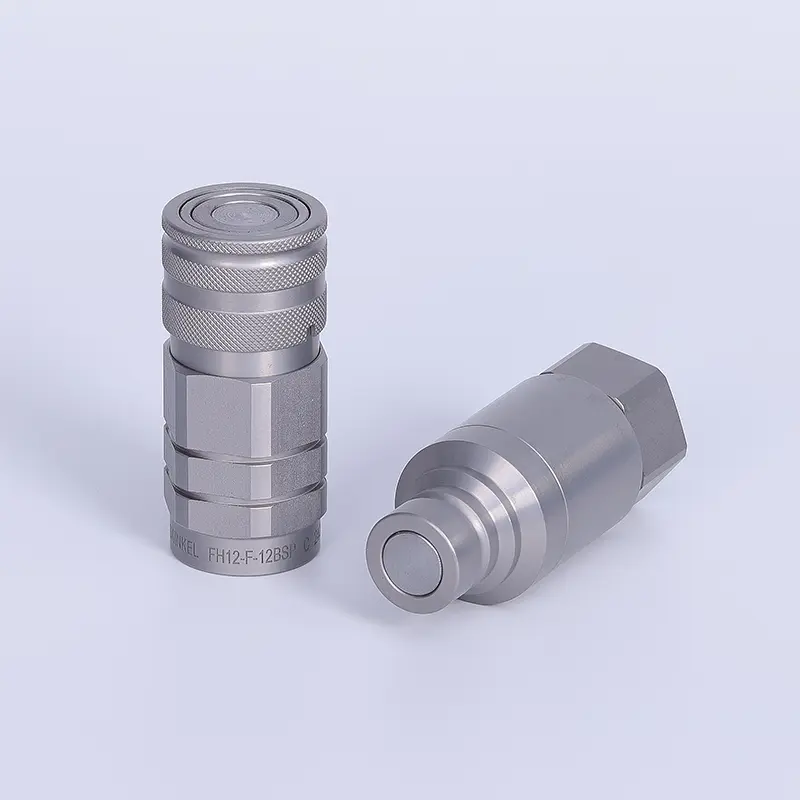
As the name suggests, face sealing relies on the tight fit of two precision-machined annular planes (or near-planes) to achieve a seal. Its core lies in a continuous surface contact area with a specific width.
Core Advantages:
High Load Capacity and Durability: The wide contact surface disperses sealing pressure, providing excellent performance against shock, vibration, and pressure fluctuations, resulting in a longer service life.
Insensitivity to Operating Conditions: It is relatively forgiving regarding the concentricity and axial alignment of the connection, offering better robustness in applications with significant vibration or slight misalignment.
High Reliability: The technology is mature, and the sealing pair is typically metal-to-metal (or composite-to-metal), offering strong resistance to pollution and media while being less prone to "nibbling" or physical damage.
Typical Application Scenarios:
High-pressure, high-flow main circuits in construction machinery.
Mining and port equipment operating in harsh environments with strong vibrations.
Industrial sectors with strict requirements for long-term maintenance-free operation and durability.
Line sealing is achieved through a sharp edge (usually a conical surface) that cuts into a softer material, such as an O-ring or elastomer seal, to form a continuous, closed annular contact line.
Core Advantages:
Superior Sealing Performance: The extremely narrow contact line translates to very high contact pressure, allowing for excellent sealing results with less locking force—particularly effective for ultra-high pressure and vacuum sealing.
Low Connection/Disconnection Force: Because it involves a "cut-in" rather than large-area friction, the force required to connect or disconnect is typically smaller, making operation lighter and faster.
Self-Cleaning Capability: During the connection process, the sharp edge can scrape away contaminants from the seal surface, providing a degree of self-cleaning.
Typical Application Scenarios:
Ultra-high pressure testing systems and aerospace hydraulic systems where there is "zero tolerance" for leakage.
Automated tool interfaces that require frequent connection/disconnection and emphasize operational feel.
Precision equipment with strict space and weight limitations.
Choosing between face sealing and line sealing is not a simple performance duel, but rather a precise matching based on core requirements.
If you pursue ultimate reliability and durability under harsh conditions, face sealing is often the more robust choice, as its "broad shoulders" can better withstand pressure fluctuations, impurities, and long-term wear.
If you pursue extreme sealing tightness, lightweight operation, or ultra-high pressure, the "precise cut" of line sealing shows its advantage by achieving the tightest seal with the smallest contact area.
The Path of Modern Technical Fusion: Many modern high-end quick couplings no longer stick to a single form. For example, composite designs use a metal face seal as the primary seal to ensure long-term reliability, supplemented by an elastomer line or face seal as a secondary seal to ensure zero leakage. This "strong-strong combination" represents the industry trend: ensuring core reliability while moving toward higher goals of zero leakage, low operational force, and extended service life.